Saturday, July 5, 2014

PHYSICS

Blogger's note: The information I will be posting today aren't mine. They were all taken during our discussion in our Advanced Physics II class with Mr. Mohamad Ali Ramber. The pictures and animations aren't also mine. Credits to the rightful owners who placed it in google.


LENS

Lens are two reflective surfaces joined together. There are two types of lenses: diverging lens and converging lens.

3 Types of Converging Lenses and Diverging Lenses


Converging lenses collects light and lets them converge in one point.
Diverging lenses scatters light, thus the word.

Note: If the distance of the object is infinite, the image formed is a point.

Equation:


Sign conventions:


Note: Converging Lens are positive lens whereas diverging lens are negative lens.


Tuesday, July 1, 2014

RESEARCH

After having our final SIP problem which was the remote controlled mop, deadline for the Chapter 1 is coming nearer. As of now, this is our chapter 1...


IMPROVISED REMOTE CONTROLLED FLOOR MOP


A Research Paper Presented to the
Science and Research Department of
Pagadian City Science High School
San Jose Heights, Pagadian City


In Partial Fulfillment of the Requirements
In Research II


Englisa, Ronna Christma C.
Conol, Annamea
Villa, Kirsteen


2014


INTRODUCTION
1.1BACKGROUND OF THE STUDY
                Cleanliness has been one of mankind’s biggest concerns in his abide. It is undeniable that cleanliness has been playing a crucial role in terms of health, comfort and virtue on man for the past millennia. However, keeping this hasn’t also been easy.
                Focusing on the most basic place in the community, -our homes –people often find household cleaning as a tiring job. There’s this feather dusting, arranging of furniture, sweeping and mopping the floors. In cleaning the floor, the all-time favorite vacuum cleaner came to solve the hardships o this task. But considering the fact that these floors are usually kept shiny and dust-free, mopping the floor is no exemption.
                This is undeniable that people are getting busier every now and then. The pile of schedules and work steal most of their times and energy. Because of this, keeping the household clean has been quite difficult to maintain compare to the situation decades ago.
                Currently, a new device has been released in the market called Sugoi Remote Control Mop by Kyosho Egg. This is a remote control mop that allows you to operate it and mop the floors without doing many efforts. Just sit on the couch and let it clean using the remote control. This innovation has been really handy for people doing the household chores. But, some flaws were observe in this device.
                First, the Sugoi Mop is quite expensive amounting to almost $40 or approximately Php 1,812. Not all people can afford this convenient mop. Considering this case, not everyone can also benefit in the comfort this mop brings.
                Second, the mop can only clean dusts from the floors and some consumers in online markets complained that it was just like a toy and not really for cleaning. Though it can make the floor shiny, this is not enough to polish quite dirty floors. This is because, the cloth used in this mop has no force to push it down the floor hence not much force is used to polish the floor. The less force is used, the less shiny and less clean.
                Although there are also existing robomops or automatic robot mops which are better than the RC floor mops, they also come with high prices making them unaffordable for people of average income.
                On the other hand, an article in an innovation website cited that there is an alternative for this remote controlled toy vehicle.

1.2 STATEMENT OF THE PROBLEM
                The main objective of this study is to produce an improvised mop which is more efficient in cleaning and is more affordable compared to the ones released in the market using materials that are easily found in malls and department stores.
                Specifically, the following sub-problems are aimed to be answer:
1.       How efficient is your improvised floor mop?
2.       What is the significant difference in the output in cleaning between the RC floor mop and the improvised one?
3.       Is there a difference in terms of effort exerted and output when using the improvised RC floor mop than the human manual mopping?

1.3 HYPOTHESIS
HO1. Radio controlled/ remote controlled cars can be efficient replacements for the body of the remote controlled mop providing that this toy car is also attached with a mop and in order to make the mop exert more effort on the floor, a block of wood or anything that is heavy enough can be used in order to push the mop on the floor.
HO2.  There is no significant difference between improvised RC mop performs similarly to the commercial remote controlled mop and though it provides a lot more comfort compared to human manual mopping, the output in human manual mopping is still better.

1.4SIGNIFICANCE OF THE STUDY
                The fact that this is remote mop and offers a great comfort and relief to people who are tired enough to clean their floor is one of its greatest asset when talking about the significance. This study allow this mop to be more affordable and more efficient in cleaning by correcting the obvious flaws such as its expensive price and the remarkably little force it exerts upon the floor resulting in it not really suitable for general cleaning.
                Generally, once this study is pursued, this will boost the mop’s potential to a higher percent and improve the quality of living on citizens around the globe particularly those who can’t afford to clean their houses anymore due to their lack of strength and endurance, at the same time make the price more affordable.
                Particularly, the housewives or those people who don’t hire helpers in their house, this innovation can lighter their loads thus, giving them more time for themselves and to do their unfinished business instead of spending the whole day, cleaning and working their bodies off.
                This study will also benefit the janitors, janitress and the workers in establishments and households as this will make their works easier and lighter at the same time, enlighten them from burdens.
                To the researchers themselves as this study will improve their creativity, hardworking attitudes, patience and develop their characters which will strengthen their foundations in the future.
                This study will also be of benefit to the market since this study will hopefully come out with an improvised, cheaper yet more efficient RC floor mop which will attract a lot of practical buyers and add on their source of income.
                This will also benefit other researchers and innovators. This study gives them additional knowledge in remote control devices opening the door of new opportunities and innovations that will benefit mankind in the future.

1.5 SCOPE AND LIMITATIONS OF THE STUDY
                This study attempts to create an improvised RC floor mop based on the models released on the market lately. The study will be conducted within the city’s vicinity chosen by the researchers and the basis for the general acceptability will be only the cleaning time and efficiency in comparison to the human manual mopping.
                This study is limited to creating only a more efficient and more affordable floor mop. The qualities of the improvised device will only be compared to the RC mops in the market. This will not include the robot mops. This study is also focused on creating an improvised RC mop that will almost equal the outputs of human manual mopping. Nevertheless, it’s not really attempting to create a device better than the traditional way of mopping.

1.6 DEFINITION OF TERMS

Mop – the improvised remote control mop
Traditional way – old way of mopping (human manual mopping)

Regular – RC Mop in the market


We already submitted this to our teacher in Research subject and he said he will return it to us soon. I know this will have corrections and revisions and I'm excited about those :)

xoxo

-Ronna

Saturday, June 28, 2014

PHYSICS

Blogger's note: The information I will be posting today aren't mine. They were all taken during our discussion in our Advanced Physics II class with Mr. Mohamad Ali Ramber. The pictures and animations aren't also mine. Credits to the rightful owners who placed it in google.


INDEX OF REFRACTION

Refraction is the bending of light.
  • Light decreases speed as it enters water
  • Light bends when it enters a region of different density.
  • The two situations above are under the "optical density"


Formula of Index of Refraction: n = c/v where n= index of refraction, c=speed of light in vacuum (3.0x10m/s), v = speed of light in the medium

Indices of Refraction

  1. Vacuum - 1.0000
  2. Air - 1.0003
  3. Water - 1.33
  4. ethyl Alcohol - 1.36
  5. Glass (fused quartz)  - 1.46
  6. Crown Glass - 1.52
  7. Light flint - 1.58
  8. Flexiglass - 1.51
  9. Sodium chloride - 1.53
  10. Diamond - 2.42
Note that the index of refraction is NEVER less than the value of 1.

REFRACTION: SNELL'S LAW


  • Light speed decreases if it travels from a region with lower than 1.0 index of refraction to a higher index of refraction.
Willebrord Snell in 1621

If n2 < n1, then θ2 > θ1 the ray then BENDS AWAY from the normal line.

Law of refraction: The incident and refracted rays lie in the same plane.

JUST FOR EMERGENCY AND FOR REMINDER IN CASE ANOTHER TEST LIKE THIS WILL BE GIVEN:


Thursday, June 26, 2014

RESEARCH

PROBLEM PRESENTATION


After days of researching different data and informations about our THREE chosen problems, we have finally arrived to the day where we had to present to the whole class these three. From the previous blog, I've already talked about our three possible SIP project. And now, we have already made the TITLE for these three possibilities:

1. GARLIC-CHILI-ONION SPRAY AS ALL PURPOSE NATURAL GARDEN PESTICIDE
2. IMPROVISED REMOTE CONTROLLED FLOOR MOP
3. KARTON BOX AS EFFECTIVE COMPONENT FOR RECYCLED PAPER BAGS

We presented in each title the background of the study.  For the background of each study, please go to the ff links:

http://www.slideshare.net/ronnachristmaenglisa/research-37609059
http://www.slideshare.net/ronnachristmaenglisa/3pp-37609061
http://www.slideshare.net/ronnachristmaenglisa/2-research

However, the problem number one got rejected because according to Sir Al, garlic right now is too expensive thus it becomes impractical. Honestly, we wanted to pursue that problem but seeing the disadvantage, we accepted it being rejected so we were left with problems number 2 and 3.

During voting, they all raised for problem number 3 which is unexpected because truth to be told, problem number 3 was more likely "for the sake" only. For the sake of having three problems and we never expected to have people root for it.

However, Sir told us that the decision is still ours. I find the third problem too simple for my liking because it is just simply making paper bag out of kartons. So my teammates and I decided that we pursue problem number two...

Improvised Remote Controlled Floor Mop.

Good luck to us

xoxo
-Ronna

Saturday, June 21, 2014

PHYSICS

Blogger's note: The information I will be posting today aren't mine. They were all taken during our discussion in our Advanced Physics II class with Mr. Mohamad Ali Ramber. The pictures and animations aren't also mine. Credits to the rightful owners who placed it in google.

II. CONVEX MIRRORS

Note: Image is always smaller in a convex mirror.

Image formation:

Most of the time, convex mirrors form a reduced, upright and virtual image.


Saturday, June 14, 2014

PHYSICS

Blogger's note: The information I will be posting today aren't mine. They were all taken during our discussion in our Advanced Physics II class with Mr. Mohamad Ali Ramber. The pictures and animations aren't also mine. Credits to the rightful owners who placed it in google.

SPHERICAL MIRRORS (CURVED MIRRORS)

I. CONCAVE MIRRORS


where: C - center of curvature, O - object, F- principal focus, f - focal length, v- vertex

Note: If the incident ray is parallel, reflected ray passes through F. If it passes F, reflected ray is parallel. And if it passes C, the reflected ray is still at C.

Defining an image: Is it real or virtual? Where is it located? Is it reduced or enlarged? Is it inverted or upright?

You can identify whether the image is reduced or larged by simply looking at the ray diagram. In the second picture, you can see that the image formed, labeled 'I', is larger than the object 'O' thus the "enlarged" in the definition.


Monday, June 9, 2014

PHYSICS

Blogger's note: The information I will be posting today aren't mine. They were all taken during our discussion in our Advanced Physics II class with Mr. Mohamad Ali Ramber. The pictures and animations aren't also mine. Credits to the rightful owners who placed it in google.

"Mirror, mirror on the wall, who is the fairest of them all?"
Where did the queen in the story Snow White say this? To the mirror.

When you want to check if you still look presentable, where do you look? Of course on the mirror or anything that will reflect your image.

Everyday day in our everyday lives, we always use MIRRORS. Although mirrors are not only used solely for seeing your own reflection, facing the mirror to see our own self is one of the most common practical uses of mirror in which almost everyone in this world does.

REFLECTION AND IMAGE FORMATION

There are different kinds of mirror. Some of these examples are the flat or plane mirror, concave mirror and convex mirror.

The Law of Reflection
  • The angle of incidence is equal to the angle of reflection: θi  = θr
  • the incident and reflected lines lie in the same plane with the normal line to the surface


Types of Reflection
1. Regular reflection - reflection on smooth surface
2. Dispersed/Scattered Reflection - reflection on rough surfaces


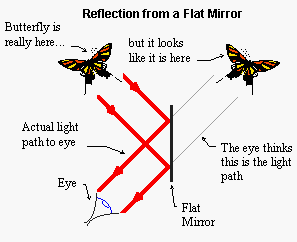
Characteristics of images formed in mirror:
  • laterally reversed
  • virtual image (as if the image is found behind the mirror; cannot be projected on screen)
  • The same size and distance with the real image
Image Formation